Radiohead's Kid A by Lin Marvin
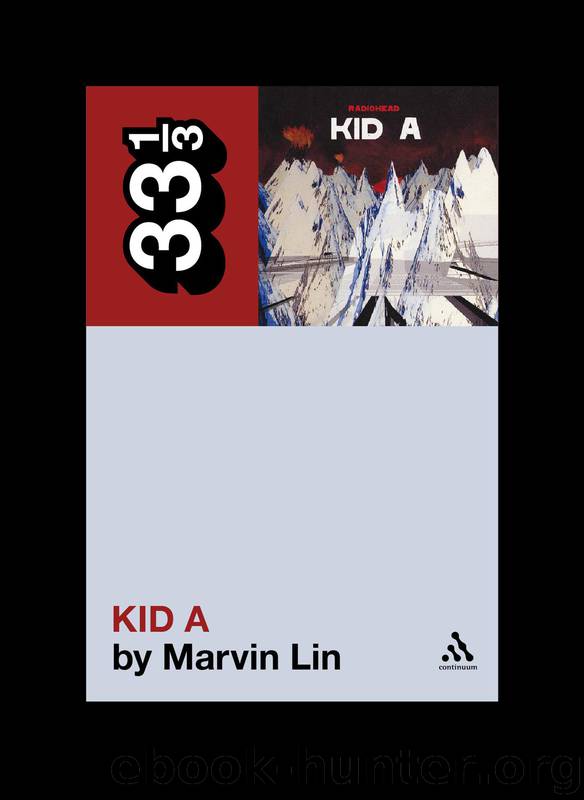
Author:Lin, Marvin
Language: eng
Format: epub
Publisher: Continuum International Publishing
Published: 2011-08-16T04:00:00+00:00
Time is the constitutive dimensions of the subject, and it is for this reason that music stands in a privileged relationship to the subject. […] It possesses the potential for this function because the defining activity of music is also that of the subject — the structuring of time. […] [This] suggests neither that music is “about” subjectivity nor that its processes are analogous to those of the subject, but rather that its processes are those of the subject, and its structuring of time is thereby a structuring of the subject.
If music’s structuring of time is a structuring of ourselves, and if our brains are literally being reshaped just by listening to “difficult” music, whether we liked Kid A is less interesting a question than whether we’d eventually like it. As Colin said in reference to what he called “a series of kickings” that Kid A received from the press, “I think we didn’t give people enough time to listen to it as a record when it first came out.” Some of the press were in fact acutely aware of this temporal phenomenon: “Kid A may feel cold and ahuman at first, but stick with it for the full 50 minutes: Listen long enough, and a fragile, flickering glow becomes apparent amid the chill” (L.A. Weekly). “It’s going to take more than a single listen for the edges to harden into shapes” (the Vancouver Sun). “Art-rock nonsense is exactly how Kid A sounded to me but, slowly, after giving the disc another chance or two, the album grabbed me to the point that I now love it without reservation” (the Edmonton Journal).
Is it any wonder, then, that Kid A, confusing to many upon release, has since become a cultural institution? I’m not saying that Kid A is an inherently “great album” that merely took time for people to “understand,” but if conceiving of Kid A as an activity helps to emphasize its inherent temporal quality, its investment in movement, its ever-looming pulse otherwise silenced by the din of mass production, then the fluidity should also help to explain why critical reactions changed so suddenly and why the album has since been “normalized” from a weird “experimental” album to one of the defining musical statements of our time. Kid A stretched our ears, shaped our brains, and structured our subjectivities. And in the process, our reactions to Kid A showed not only how we’re continually adapting to and learning from music as time passes, but also how both music and time are not static and universal, and how the pleasures we feel from the former are wholly dependent on the ticking of the latter.
Download
This site does not store any files on its server. We only index and link to content provided by other sites. Please contact the content providers to delete copyright contents if any and email us, we'll remove relevant links or contents immediately.
The Great Music City by Andrea Baker(33551)
Aircraft Design of WWII: A Sketchbook by Lockheed Aircraft Corporation(32382)
Call Me by Your Name by André Aciman(20711)
The Secret History by Donna Tartt(19466)
The Art of Boudoir Photography: How to Create Stunning Photographs of Women by Christa Meola(18758)
Shoot Sexy by Ryan Armbrust(17847)
Plagued by Fire by Paul Hendrickson(17534)
Portrait Mastery in Black & White: Learn the Signature Style of a Legendary Photographer by Tim Kelly(17103)
Adobe Camera Raw For Digital Photographers Only by Rob Sheppard(17081)
Photographically Speaking: A Deeper Look at Creating Stronger Images (Eva Spring's Library) by David duChemin(16797)
Ready Player One by Cline Ernest(15139)
Pimp by Iceberg Slim(14786)
Bombshells: Glamour Girls of a Lifetime by Sullivan Steve(14215)
The Goal (Off-Campus #4) by Elle Kennedy(13961)
Art Nude Photography Explained: How to Photograph and Understand Great Art Nude Images by Simon Walden(13144)
Kathy Andrews Collection by Kathy Andrews(12087)
The Priory of the Orange Tree by Samantha Shannon(9359)
The remains of the day by Kazuo Ishiguro(9214)
Thirteen Reasons Why by Jay Asher(9110)
